Keywords first — AI second
A fast keyword pass removes obviously irrelevant messages, and AI analyzes only the remaining candidates. You keep semantic filtering while reducing unnecessary AI requests.
- For whom
- Sales / monitoring / analytics
- Industry
- AI filtering · Cost optimization
- Setup
- One filter cascade
- Result
- keywords → AI · fewer requests
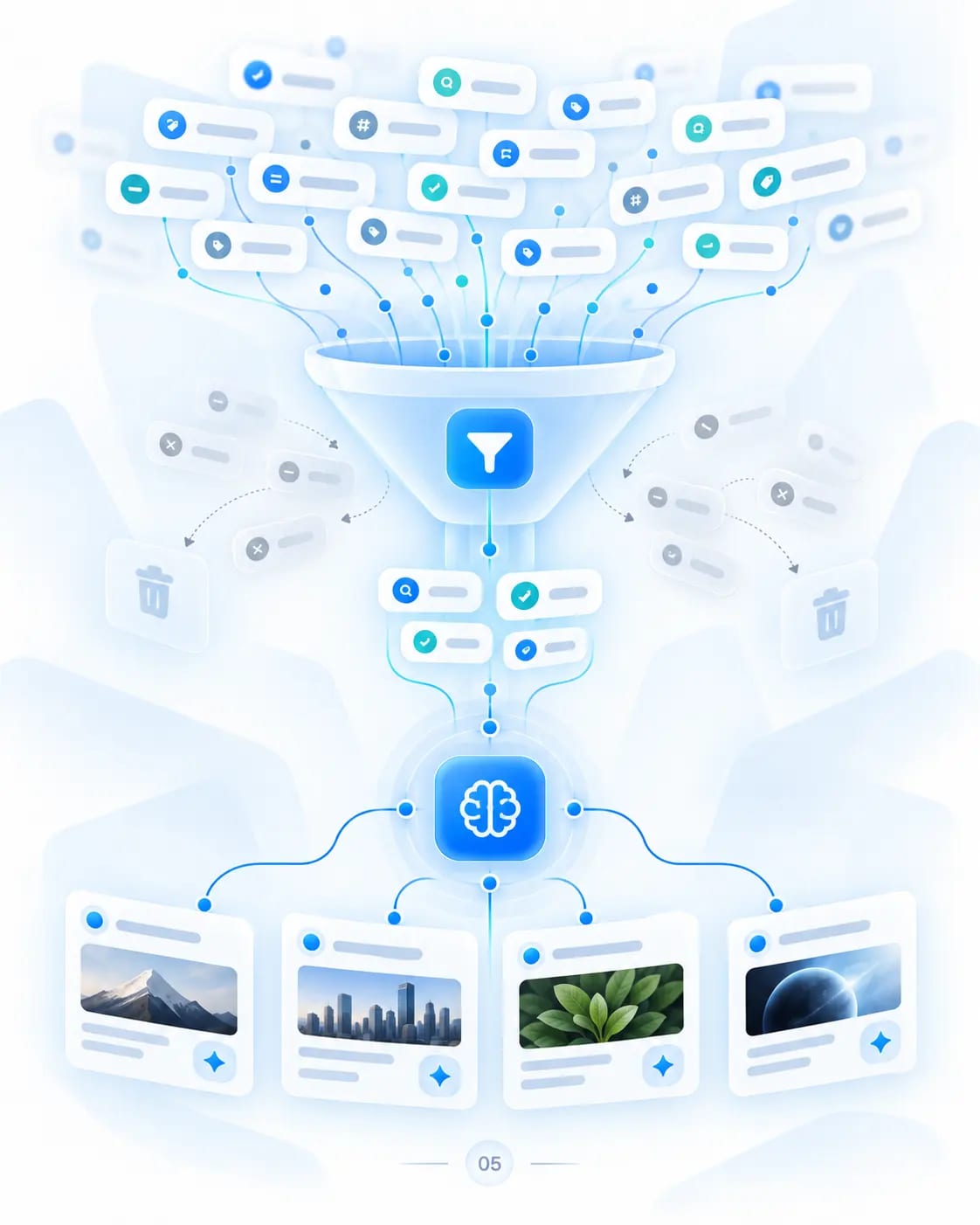 keywords → AI · fewer requests
What needs to be automated
«Sending every message from active sources to AI wastes requests on obviously irrelevant content. Keywords alone, however, are often not precise enough for semantic filtering.»
How tgcparser X handles it
Step 1. Define base keywords
Choose words and phrases that quickly remove messages clearly unrelated to your task.
Step 2. Add exclusions
When useful, add stop words to remove ads, provider offers or other known noise before AI is called.
Step 3. Add AI filtering
Only messages that pass the first filter are sent to AI for meaning, intent and relevance evaluation.
Step 4. Keep only messages that pass both stages
The final result can be published, delivered as a notification or saved to CSV/TXT.
Step 5. Tune each stage independently
As the source stream changes, adjust keywords and the AI instruction separately without rebuilding the whole project.
«Two-stage filtering reduces the amount of AI analysis without giving up semantic checks»
- 01
- 2 stages
- 02
- AI
- 03
- Efficiency
fast filtering plus semantic AI verification
receives only pre-filtered candidate messages
fewer unnecessary model requests
20 competitor channels — one structured report
tgcparser collects posts and available metrics from selected channels for a chosen period, helps filter the dataset, and saves the result to CSV/TXT for further analysis.
Explore workflowLead generation · AIOne AI request instead of a long keyword list
Describe what a relevant message looks like. tgcparser monitors selected sources, AI evaluates meaning and intent, and matching results are saved with context and a source link.
Explore workflowChannel network · AutopostingMultiple channels and projects — one control layer
Split different channels and jobs into projects with their own sources, processing, schedules, Telegram/MAX accounts and destinations. Each project runs independently while management stays in one system.
Explore workflowTry the full functionality for 24 hours
Start with short access or choose a long-term plan right away. If you want help with setup, choose the “Done for you” option.
Full functionality · 24 hours · 990 ₽ · no auto-renewal